
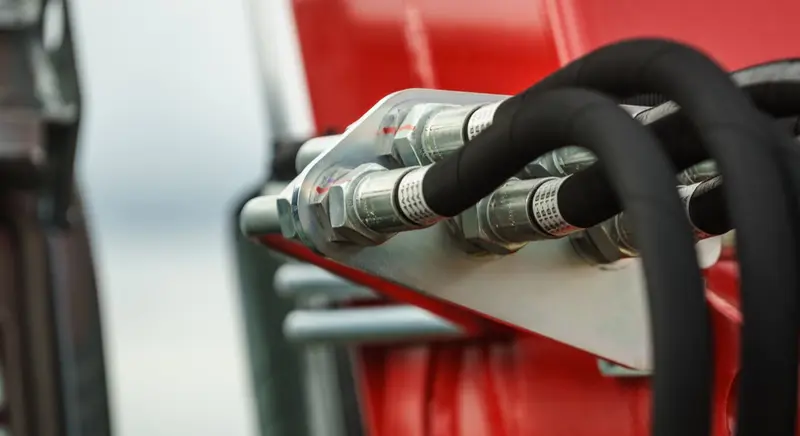
If the same hydraulic hose position has failed again, do not treat it as another isolated parts order. Stop the equipment under the procedure that controls the work. Preserve the current installed context, then put the prior replacement record beside it before another assembly is specified.
The repeat event does not prove that the hose, installation, routing, pressure, fluid, or machine caused the failure. It does show that the open question survived the last repair. The useful next step is a clean comparison that qualified hose or equipment personnel can audit.
Stop the next parts order from erasing the evidence
A failed assembly, its installed route, and the machine condition at shutdown can change as soon as work begins. If a hose has already failed, start with the safe first steps after a hydraulic hose failure. Do not move closer just to improve the record.
Turning off the engine does not prove that hydraulic energy is controlled. Where OSHA’s general-industry lockout/tagout rule applies, the employer’s energy-control procedure must address shutdown, isolation, stored or residual energy, and verification before servicing begins. Follow the machine manual and the employer procedure for the equipment and task. OSHA’s lockout/tagout booklet summarizes the covered requirements.
Never search for a hydraulic leak with a hand or bare skin. Do not loosen a fitting, rotate or flex a hose, remove a guard, or pressurize and cycle the machine to recreate the failure. The Health and Safety Executive’s high-pressure fluid guidance identifies bare-hand leak searches and failure to release pressure as dangerous practices. A suspected fluid-injection injury needs immediate professional medical treatment, even when the wound appears small. See the HSE hydraulic-injection safety alert.
If the required safe state and access have not been established, stop at existing records and observations available from a safe position. Disconnection, removal, inspection, testing, and return-to-service decisions stay inside the controlling procedure and qualified authority.
Confirm which hose position failed again
“Same hose” needs a traceable identity. Start with the machine manufacturer, full model, serial or product identification number, fleet number, and attachment. Then name the hose by function and its two connected components, such as the valve end and cylinder end.
Match the current route to the prior record. A similar outside diameter, fitting shape, or location in a hose bundle does not establish that it is the same application. Record the visible layline or label exactly, but leave unreadable characters and unverified meanings unresolved.
If the old record names a provider assembly number, OEM part number, work order, invoice line, or label ID, keep the identifier with its source. Do not reconstruct missing pressure, hose construction, fitting, fluid, or crimp details from memory. “Not documented” is a useful finding when the earlier file does not contain the answer.
Capture the current event before the context changes
Collect only what can be observed without entering a hazard area or manipulating the failed assembly. Tie each item to the unit, hose position, date, and person who recorded it:
- The machine and attachment position when work stopped.
- The function being commanded and what the operator observed immediately before shutdown.
- A wide view of the visible installed route, followed by both connection areas when safe access permits.
- The exact failure position along the named route, without touching, cleaning, or exposing it.
- Nearby adapters, clamps, sleeves, guards, pass-throughs, bends, and visible contact surfaces.
- The visible layline, provider label, and other identifiers in full-resolution images.
- Alarms, warnings, unusual sound, loss of function, or temperature indication reported by the operator, without assigning a cause.
Do not restart, articulate, raise, lower, or reposition the machine to make a condition appear again. Record the shutdown position and the operator’s factual account. Mark remembered details as reported observations, not measurements.
When visible wear sits beside a support or contact surface, use the separate rub-point and routing documentation guide for that photo task. The repeat-failure file should reference those images rather than restate a routing prescription.
Put the last replacement beside this event
Retrieve the prior work order and the hose replacement closeout record when one exists. Look for the verified assembly identifier, replacement date, meter reading when recorded, attributed finding, parts or supports changed, finished-route photos, release status, restrictions, and follow-up assigned at that time.
Keep attribution intact. “Operator reported oil near the upper guide” is not the same as “technician confirmed abrasion at the guide.” A prior invoice that says only “hose replaced” does not establish why it failed or whether another condition was evaluated.
Now compare the two records in time order. Which machine, attachment, hose function, connection points, and assembly identifiers match? Which route, support, sleeve, adapter, fluid record, attachment, valve, or other work changed between events? Which prior follow-up was completed, remained open, or was never documented?
The comparison should expose gaps as clearly as matches. If the prior route photos are missing, say so. If the current event has no meter reading, leave it blank. A missing record is not proof that an inspection, correction, or test did not happen.
Turn repetition into better questions
Danfoss tells maintenance readers that when failures on the same equipment keep recurring, the task changes to determining and correcting the cause. Its hydraulic hose catalog’s repeated-failure section separates application, assembly and installation, external damage, equipment, and the hose itself as different areas for qualified review.
Do not turn that list into a remote diagnosis. Use the evidence to ask narrower questions. If the damage appears at the same point, ask whether the prior and current photographs show the same relationship. If the assembly identifiers differ, ask what specification controlled each selection. If the route changed, ask who recorded the change and what requirement it addressed.
Pressure, temperature, fluid compatibility, hose size, ends, routing, and assembly method remain separate checks. The Gates Safe Hydraulics manual treats accurate maintenance records, inspection, troubleshooting, selection, assembly, routing, and installation as connected parts of a maintenance program. The record points qualified personnel to the right questions; it does not answer those checks by itself.
Preserve a cause only when a qualified evaluator or controlling record established it. Otherwise use “cause not established” and list the unresolved question. Do not create a universal rule that two failures prove a system problem, a bad hose, or poor installation.
Send one repeat-failure case file
Keep the prior and current evidence together under the same fleet unit and hose position. A practical case file can include:
- Machine, attachment, hose function, and named ends.
- Current event date, meter reading when available, and operator-reported timeline.
- Current route, connection, identifier, and failure-location images collected safely.
- Prior work order, verified assembly identifier, route images, attributed finding, recorded correction, release status, and follow-up.
- A dated list of known equipment, attachment, adapter, route, support, sleeve, fluid, or service changes between events.
- Open questions, estimates labeled as estimates, and missing fields labeled “not documented.”
- The complete failed assembly and related protection retained only after qualified removal and only when site and environmental procedures allow it.
Keep original images at full resolution and label copies by unit, date, hose position, and source. Do not crop away the route context or turn an operator’s caption into a confirmed technical finding.
This file cannot establish the correct replacement specification, hidden reinforcement condition, pressure behavior, contamination, root cause, or safe return to operation. Those decisions require the machine documentation, manufacturer data, controlling workplace procedures, and qualified evaluation.
To start a service conversation, contact SIG with the equipment location, machine identity, and repeat-failure record.
Sources
- OSHA: Control of Hazardous Energy (Lockout/Tagout)
- Health and Safety Executive: High-Pressure Fluid Injection Hazards
- Health and Safety Executive: Hydraulic Injection Injury
- Danfoss: Aeroquip Rubber Hydraulic Hose & Fitting Catalog
- Gates: Safe Hydraulics Manual, hosted by the National Transportation Safety Board