
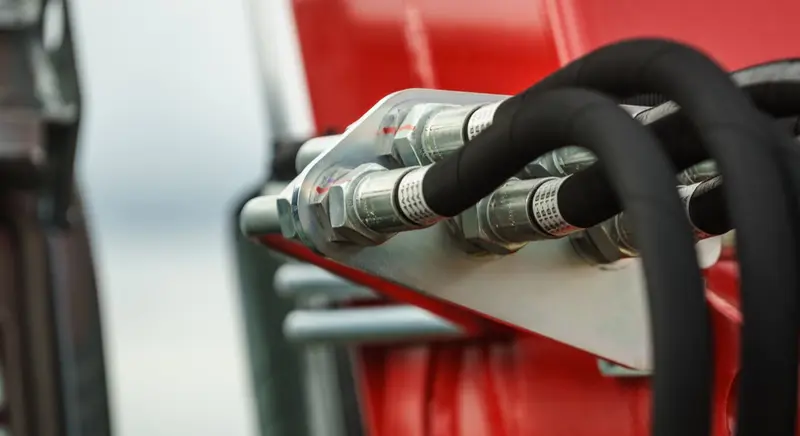
Contamination control starts before a hydraulic connection is opened. The most useful preparation can happen while the hydraulic circuit remains closed. The machine manual and employer procedure control the actual servicing sequence.
That handoff matters. A clean-looking fitting does not prove that an open port, disconnected line, or new assembly is clean inside.
Stop at the closed system
Turning off the machine does not authorize anyone to disconnect a hydraulic line. Where OSHA’s general-industry lockout/tagout rule applies, energy isolation must be performed by authorized employees doing the servicing. Before work begins, an authorized employee must also verify that isolation and de-energization have been accomplished. See OSHA’s control-of-hazardous-energy standard.
Stored or residual energy may require machine-specific steps before servicing. Do not loosen a fitting, remove a guard, wipe a suspected leak, or cycle controls to make the hose easier to reach.
If a hose has failed, use the safe first steps after a hydraulic hose failure before collecting service information. Never use a hand to check a hydraulic hose for leaks; have a qualified person check a suspected leak. Hydraulic fluid injection can be serious even when it causes little pain, so seek immediate medical attention. The K-State tractor safety manual hosted by OSHA gives both warnings.
Prepare facts, not an opened connection
Build a short record that separates known facts from estimates:
- Copy the hydraulic-fluid product and specification from the machine manual, service record, reservoir label, or supplier record when available.
- Photograph the installed route and both connections only from a safe position.
- Note visible mud, dust, standing water, loose debris, active nearby work, and access limits around the repair area.
- Record whether a connection may already have been exposed, who observed it, and what happened next.
Do not choose a connection-cleaning method as an operator-preparation step. Leave the fitting, sleeve, guard, filter, reservoir, and suspected leak alone until the authorized technician applies the controlling procedure.
Tie each observation to a time and place. A note such as “boom line at the valve block, uncovered when found at 10:20 a.m.” is more useful than “hose was dirty.” Include the person who observed it and whether the machine remained isolated afterward. Do not fill gaps with a likely cause.
The broader mobile hose service information checklist covers machine identity, fittings, fluid, location, access, and approvals. Keep this record narrower. Its job is to preserve contamination-related conditions at the handoff.
What changes when the circuit is opened
Once a line is disconnected, the work has crossed from preparation into servicing. A Danfoss pump service manual shows the kind of controlled sequence a manufacturer may require: clean the surrounding area, clean the component exterior, tag hydraulic lines, cap disconnected lines, and plug open ports. That procedure is specific to the covered Danfoss pumps, but it demonstrates why the correct machine and component instructions must control the work. See the Danfoss H1P service manual.
A cap or plug is a contamination control, not proof that the system is pressure-free. Line identification belongs in the service procedure, not in an operator’s guess.
A new assembly still needs a cleanliness handoff
New does not mean ready to install without verification. Danfoss says hose cutting can leave rubber dust and metal particles, while crimping can leave metal flashings. Its contamination-control material treats cleaning and protection against recontamination as separate steps. See the Danfoss contamination-control guide.
The British Fluid Power Association makes the same lifecycle boundary clear. Its hose-assembly cleanliness guidance covers final cleaning, cleanliness validation, delivered cleanliness, and user maintenance. It also says the guidance applies to mobile hose replacement, trade counters, hose assemblers, and users. See BFPA/P111 hose-assembly cleanliness recommendations.
These sources do not establish one universal cleaning method for every assembly. Do not improvise with shop air, solvent, rags, tape, makeshift plugs, or an unverified cleaning projectile.
Keep protected ends protected
Caterpillar’s installation guide tells technicians not to remove contamination caps or plugs from a hose assembly until just before installation. It also keeps stored assemblies off the floor, with their ends covered. See Caterpillar’s Hose and Connector Installation Guide.
That is a useful inspection question at the handoff: were the assembly ends still protected when the technician received it? The answer is evidence, not a cleanliness certificate.
Do not remove a protector for a better photo. Do not force a loose cap back onto a fitting. Danfoss warns that forcing ill-fitting caps or plugs can shear plastic particles into an assembly.
Record an exposure without diagnosing the system
Sometimes the technician arrives after another person has already removed a hose or left a port uncovered. Do not declare the system clean or contaminated from appearance alone. Preserve what can be stated honestly:
- which connection or hose end was open;
- the estimated time the opening was first noticed;
- whether the opening faced up, down, or sideways;
- nearby dust, rain, mud, grinding, cutting, demolition, or vehicle traffic;
- any covering that was already present; and
- any fluid loss, refill, or work reported by the people involved.
Label estimates as estimates. A photo taken after the fact cannot show everything that entered an opening, and a dry exterior cannot prove the inside remained clean.
Photos and exposure notes cannot determine whether filtration, flushing, fluid replacement, sampling, or component inspection is required. Those decisions belong to qualified personnel using the machine manual, applicable cleanliness requirements, and the facts of the exposure.
Ask for a closed-loop handoff
A useful closeout answers three questions. Which connections were opened? How were those openings and the replacement assembly protected? What contamination concern, if any, still needs evaluation? Record the technician’s attributed answer instead of converting it into a claim that the whole hydraulic system is clean.
The hydraulic hose replacement record guide owns the broader closeout step.
When the machine identity, documented fluid, equipment location, and site conditions are ready, review SIG’s on-site hose fabrication scope and regional service area, then request mobile hose service. Contact SIG to confirm scheduling and whether the required assembly is supported.
Sources
- OSHA: 29 CFR 1910.147 — The Control of Hazardous Energy
- K-State Research and Extension: Tractor Safety Manual
- Danfoss: H1P 069–H1P 280 Axial Piston Single Pumps Service Manual
- Danfoss: Contamination Control Products
- British Fluid Power Association: BFPA/P111 Hose-Assembly Cleanliness Recommendations
- Caterpillar: Hose and Connector Installation Guide