
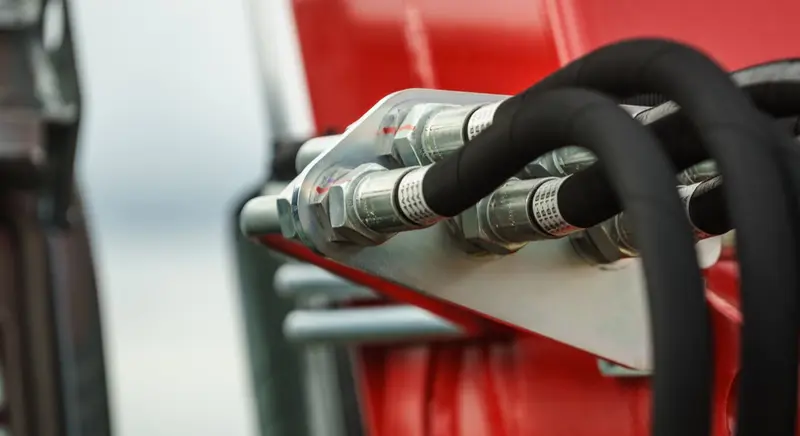
The best information to have ready for mobile hydraulic hose service is a safe machine status, exact location, machine identification, failed-hose function, readable hose markings, clear photos of both fittings and the full route, fluid information, site-access details, and a decision-maker’s contact information. That record helps a technician understand the situation before arriving without asking an equipment operator to guess at a fitting or work around stored hydraulic energy.
SIG Hydraulics provides mobile hydraulic hose service for Northeast Ohio and Western Pennsylvania equipment owners. This checklist helps operators collect the information that makes a service call safer and more efficient.
Start with safety, not the hose part number
Before collecting close-up measurements or touching a connection, follow the machine manufacturer’s shutdown and energy-control procedure. Hydraulic circuits can store energy after the engine is off. Raised attachments and suspended loads add gravitational energy; accumulators and trapped circuit sections can retain pressure.
The OSHA control-of-hazardous-energy standard requires hazardous energy to be controlled during covered servicing and maintenance. OSHA’s hydraulic lockout interpretation explains that potentially hazardous stored or residual hydraulic energy must be relieved, disconnected, restrained, or otherwise rendered safe. Employers remain responsible for the procedures, training, and task-specific controls that apply to their workers and equipment.
Use the equipment operator’s manual and the employer’s written program. Do not improvise a universal pressure-relief sequence from a blog post. Do not loosen a fitting to “see whether pressure is gone,” and never search for a pinhole leak with a hand. If the machine cannot be made safe by an authorized person, provide information that can be collected from a distance: machine records, wide photos, warning codes, operator observations, and the site contact.
Our guide on what to do after a hydraulic hose failure is a preparation reference. It does not replace the OEM procedure or promise a specific response time.
A one-page information checklist
Keep this list in your maintenance system, machine folder, or phone notes. The goal is not to diagnose the repair yourself. The goal is to remove avoidable uncertainty.
Machine and component
- Machine manufacturer and complete model
- Serial number, product identification number, or unit number
- Year, when known
- Attachment manufacturer and model, if the hose is on an attachment
- Component served by the hose: boom, steering, auxiliary circuit, grapple, lift, travel, brake, cooling, or another function
- OEM hose or component part number, if readable in a parts diagram or service record
Hose and fittings
- Full hose layline, photographed in readable sections
- Any stamped fitting, adapter, valve, or port markings
- Clear view of both hose ends
- Straight, elbow, flange, or other end style
- Visible seal type, only when already safely exposed
- Overall route and approximate length, without moving an unsafe assembly
- Sleeve, guard, clamp, or abrasion protection present before failure
- Evidence of rubbing, heat exposure, twisting, kinking, crushing, corrosion, or pull
Failure and fluid
- What the operator observed immediately before shutdown
- Exact point where fluid appeared
- Whether failure was sudden or a gradually worsening leak
- Any alarms, fault codes, unusual noise, drift, slow movement, or loss of a function
- Fluid type or OEM specification from the machine record
- Estimate of fluid lost, clearly labeled as an estimate
- Containment and environmental response already taken
Location and access
- Street address or GPS pin
- Gate, building, pit, field, floor, bay, or job identifier
- Best entrance for a service vehicle
- Surface and access conditions: pavement, soft ground, slope, low clearance, security gate, or restricted area
- Site rules, PPE, check-in, escort, training, or badging requirements
- Safe parking and working space near the equipment
- On-site contact and backup contact
Authorization
- Person authorized to approve work
- Purchase-order or not-to-exceed requirement
- Billing contact
- Tax-exempt or vendor-onboarding requirements, if applicable
- Required inspection, testing, documentation, or return-to-service sign-off
The Gates hydraulics training program teaches a S.T.A.M.P.E.D. hose-application procedure and coupling identification as part of manufacturer training. That reflects an important principle: selecting a hose assembly requires application information, not only a matching thread.
1. Give the exact machine identity
“Yellow excavator” is not enough. Record the manufacturer, full model designation, and serial or product identification number exactly as shown on the machine plate. Different production ranges of the same model may use different pumps, valves, attachments, ports, and hose routings.
If the hose is on a quick coupler, hammer, mower, grapple, snow attachment, or other add-on, record the attachment separately. The host machine and attachment may come from different manufacturers and use different connector systems. Photograph both identification plates.
Add your own fleet number if you use one. A fleet identifier helps the site contact, dispatcher, maintenance manager, and technician discuss the same machine when several similar units are present.
If you can locate an OEM hose part number in a current parts catalog, record the catalog source and machine serial range along with the number. Do not assume that the hose currently installed is original or correct. Previous repairs may have changed adapters, routing, or assembly length.
2. Describe the hose by function and route
The phrase “main hose” means different things to different people. Describe what stops working when the hose loses pressure and where the hose runs.
Useful examples are:
- “left boom cylinder base-end hose”;
- “auxiliary return line from the attachment manifold”;
- “steering hose entering the orbital valve”;
- “loader lift circuit hose behind the right arm”; or
- “fan-drive hose between the valve block and motor.”
Take one wide photo that shows the machine area, then several closer photos that trace the route from end to end. Include clamps, pass-throughs, protective sleeves, bends, and areas where the hose moves as the machine articulates. A close-up of a split cover is useful, but it cannot reveal whether the original routing caused abrasion or tension.
Do not cycle unsafe equipment just to improve a photograph. If a raised attachment blocks the view, follow the OEM procedure for safely lowering or mechanically supporting it. If that cannot be done by an authorized person, wait.
3. Photograph the layline before cleaning it away
The printed layline on a hydraulic hose may identify the manufacturer, hose family, size, standard, pressure rating, date or lot code, and other product information. Dirt and abrasion can make it difficult to read, so photograph every legible section in good light.
Use a dry cloth only when the equipment is safely isolated and the hose surface can be approached without exposure to fluid, movement, heat, or sharp wire reinforcement. Do not use a solvent that could damage the cover or erase markings. Do not rotate a pressurized or tensioned hose to face the camera.
Capture several overlapping images rather than one distant image. Keep the originals at full resolution. Transcribe the text into the maintenance note, but attach the photo too; a character such as “1,” “I,” or “L” can be misread.
The hose layline is evidence, not the complete specification. The replacement still must match the machine application, fittings, fluid, temperature, routing, and validated hose-and-coupling system. The Gates hydraulic products catalog provides manufacturer-specific selection, assembly, installation, and safety information that illustrates why a hose name alone is insufficient.
4. Photograph both fittings and every adapter
Photograph each connection from several angles before anything is removed. Start wide enough to show which component the fitting enters. Then capture the hose fitting, swivel nut, elbow, adapter, flange halves, port, and visible seals.
Label the photos by machine position, such as “valve end” and “cylinder end.” Do not rely on file order. If an adapter remains in the component while the hose is removed later by a qualified person, make that distinction clear. Otherwise, a photo may cause someone to identify the adapter thread instead of the hose-end thread.
For JIC, ORFS, NPT, BSPP, and metric screening clues, use our hydraulic hose fitting identification guide. It explains why the thread, seat, seal, taper, diameter, and pitch must agree. Do not order a fitting solely from a picture or from a connection that turns one or two threads by hand.
5. Record measurements without creating a hazard
A safely removed hose can provide useful dimensions, but removal is a servicing task. It belongs to a trained, authorized person following the applicable energy-control and environmental procedures.
When the assembly is already safe and available for measurement, useful records include:
- overall assembly length using the manufacturer’s stated measuring convention;
- hose inside-diameter or dash-size identification from the layline or catalog;
- fitting thread diameter and pitch measured with suitable tools;
- fitting angle and relative elbow orientation;
- sleeve and guard locations; and
- orientation marks showing how the hose sat before removal.
Do not cut off an end to make it easier to photograph. Do not straighten an elbow, grind a ferrule, pry out a seal, or discard an adapter. Bag and label the complete assembly so it can be examined. Cap open machine ports using the appropriate clean protective method specified by the manufacturer or site procedure.
SIG’s mobile hose fabrication service brings supported assembly work to the equipment. A complete, clearly labeled record can make the first conversation more productive.
6. Explain what happened before the leak
The last few minutes of operation can help separate a visibly damaged hose from a system problem that also needs attention. Ask the operator for a factual timeline:
- What task was the machine performing?
- Which control was being used?
- Was the attachment near the end of travel?
- Did movement become slow, jerky, or weak?
- Was there a noise, alarm, smell, or temperature warning?
- Had the area been wet or oily during earlier inspections?
- Was the hose recently replaced, rerouted, or disturbed?
- Did the machine strike debris or work near a heat source?
Record observations without assigning a cause. “Cover worn through where it touched a bracket” is more useful than “bad hose.” “Fluid appeared when the boom was raised” is more useful than “pump problem.” Root-cause assessment comes after the system is safe and the evidence is inspected.
For routine planning, the hose-failure warning-sign checklist can help operators document changes before a breakdown. Any inspection procedure still has to follow the machine manufacturer and employer safety program.
7. Identify the hydraulic fluid from records
Do not identify hydraulic fluid by color alone. Color changes with dye, age, contamination, oxidation, mixing, and lighting. Use the machine manual, service record, reservoir label, supplier record, or a documented fluid-analysis program.
Record the product name and specification when known. Note any recent top-off, fluid change, contamination concern, or incorrect-fluid event. If a hose failure released fluid, preserve the spill-response and disposal records required by the site.
Never taste, smell closely, or handle an unknown fluid to identify it. Safety data, OEM requirements, and facility procedures control the response. A hose and seal material must be compatible with the actual fluid and operating conditions.
8. Send a location that a service vehicle can use
A mailing address may lead to a large quarry entrance while the machine sits miles away. Send a dropped map pin plus written directions from the gate. Name the building, floor, bay, field, pit, road, or job number.
Describe access honestly:
- gate width and lock instructions;
- low bridges or overhead doors;
- soft shoulders, mud, steep grades, or seasonal restrictions;
- mine, rail, airport, utility, or secure-facility controls;
- check-in time and required escort;
- available light and working clearance; and
- whether another machine blocks the safest approach.
SIG Hydraulics provides direct mobile coverage rather than operating a walk-in counter. The service-area overview and the Salem service-area page describe the home market. Contact SIG with the exact equipment location to confirm scheduling.
9. Clarify the site’s approval process
An equipment repair can stall even when the technical problem is clear. Before requesting service, identify who can approve work, who can sign a work ticket, and whether a purchase order is mandatory.
For commercial, municipal, industrial, or federal sites, prepare vendor-onboarding requirements in advance. Include billing address, tax status, insurance documentation requests, safety orientation, badging, cybersecurity or portal requirements, and required test records. Do not send sensitive payment or identity documents through an ordinary contact form unless the form explicitly requests them and provides an appropriate secure process.
If several people must approve work, designate one on-site point of contact. Provide a backup who can answer when the primary contact is in a meeting or outside coverage.
A practical photo sequence
Use this sequence to create a coherent record:
- Machine from the side, with unit number visible.
- Machine model and serial plate.
- Attachment identification plate, if applicable.
- Wide view of the failed circuit area.
- Hose route from the first component.
- First hose end and any adapter.
- Hose layline in overlapping sections.
- Suspected damage area, without touching it.
- Second hose end and any adapter.
- Access path and safe work area.
Add a short caption to every photo. If a photo shows an estimate or uncertain identification, say so. Do not post machine serial numbers, facility access codes, customer information, or sensitive site layouts publicly.
What not to send as the only information
Avoid these common dead ends:
- “I need a half-inch hose.” Half-inch may refer to several unrelated dimensions.
- “It is a standard fitting.” The local fleet may contain several standards.
- One extreme close-up with no machine context.
- A screenshot that compresses the layline until it is unreadable.
- A fluid color with no product or OEM specification.
- An approximate town without a site pin or access directions.
- A request for “ASAP” without saying whether the equipment is safely shut down.
- An old parts number without a model and serial-range check.
The hydraulic hose FAQ answers common questions, and the mobile hose repair page explains the service scope.
Build the record before a breakdown
The best time to record machine plates, common hose routes, site access, approval contacts, and fluid specifications is before a breakdown. Add the checklist to preventive-maintenance inspections. Save the files under the fleet unit number and update them after attachments, adapters, valves, or hose routes change.
SIG Hydraulics is one focused business: mobile hydraulic hose service. You can read about SIG Hydraulics and request service. Contact SIG with the exact equipment location, machine details, and safely collected hose information.