
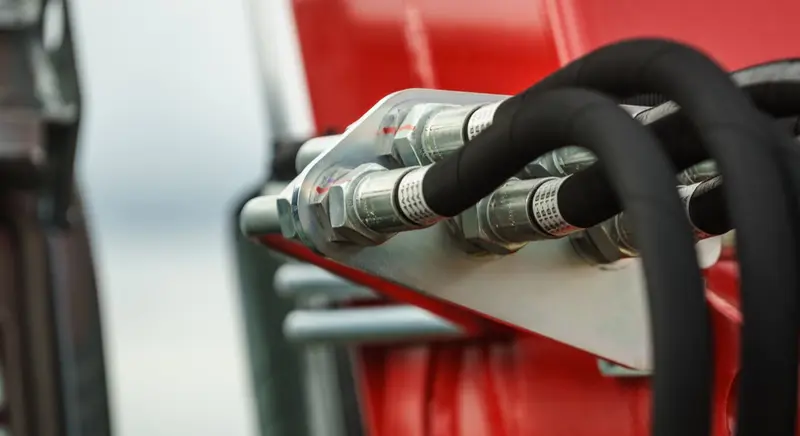
No—a higher pressure rating by itself does not make a hydraulic hose an acceptable replacement. It clears only one part of the selection problem. The complete hose assembly still has to match the machine and application requirements for size, temperature, fluid, fittings, routing, movement, and manufacturer-approved assembly components.
That distinction prevents a tempting shortcut: “The replacement has a higher working-pressure number, and the ends look the same, so it must be safer.” The larger number does not answer whether the hose belongs on that circuit.
Read the pressure number correctly
Start with maximum working pressure, not burst pressure. Parker’s hose safety guide says the published maximum working pressure of the hose, fittings, and assembled product must meet or exceed the system maximum. It also states that the assembly maximum is limited by the lower-rated hose or fitting. See the Parker safety guide for hose selection.
Burst pressure does not provide extra operating room. Parker describes it as a manufacturing-test value and says it is not an allowance to operate above the published maximum working pressure. A hose label or catalog entry that lists a burst value is therefore not giving permission to run the assembly at that value.
Pressure spikes matter too. The Gates Hydraulic Maintenance & Safety guide says a hose’s published working pressure must be equal to or greater than normal system pressure and the surges it will encounter. Danfoss likewise notes that rapid pressure surges may not appear on many common gauges and that exposure above maximum operating pressure shortens hose life. See the Danfoss AQP installation guide.
So a higher published working-pressure rating can be relevant, but it cannot stand in for the system pressure information. Use the machine documentation and applicable manufacturer data; do not estimate the requirement from a dashboard gauge or from the old hose’s appearance.
Pressure is one line in the specification
Gates organizes hose selection with the acronym STAMPED: Size, Temperature, Application, Material, Pressure, Ends or Couplings, and Delivery.
Before a replacement can be accepted, qualified personnel need a consistent answer for the complete application:
- Size: The required hose inside diameter and the machine’s flow needs still apply. Similar outside diameter does not establish the correct inside diameter.
- Temperature: The hose must fit the documented fluid and ambient temperature range for the application.
- Application: Equipment movement, impulse exposure, bend requirements, routing, abrasion, and other machine-specific conditions remain part of selection.
- Material: The hose tube, cover, fittings, seals, and O-rings must be compatible with the conveyed fluid and surrounding environment.
- Pressure: The finished assembly’s published maximum working pressure must cover the system maximum, including applicable surges.
- Ends and assembly system: Connection type, sealing surface, hose, stem, ferrule, and assembly method must form a manufacturer-approved combination.
- Delivery: Hose size must support the application’s required fluid delivery without substituting a guess based on what can be made to fit.
A second hose can satisfy the pressure line and still fail elsewhere in that list. Pressure is a requirement, not a universal compatibility certificate.
Matching-looking ends do not settle the question
Two fittings can appear similar while using different threads, seats, sealing surfaces, or component systems. The correct connection has to be identified by thread, seat, seal, and measurement rather than by whether it starts threading onto a port.
That identification is separate from deciding whether the hose construction and fitting components are approved to work together.
Parker’s safety guide warns against combining a hose, fitting, or related component from different manufacturers unless the combination is approved. A fitting that can be inserted or attached is not necessarily a validated assembly system. The finished assembly rating and compatibility come from the approved combination and the manufacturer’s current instructions—not from the rating printed on the hose alone.
Do not use a loose old fitting as the sole specification, and do not ask someone to transfer or recrimp an unknown component because it appears reusable. Preserve the complete old assembly for qualified comparison when the controlling procedure allows it.
A higher rating does not predict how the hose will fit
A higher-pressure hose is not automatically larger, smaller, stiffer, more flexible, longer-lasting, or better protected from abrasion. Those properties depend on the specific hose construction and manufacturer data.
What matters on the machine is whether the selected assembly can follow the documented route without violating bend requirements, twisting, rubbing, pulling at the fittings, blocking guards, or interfering with moving parts. Parker treats routing, mechanical loads, abrasion, and proper end fittings as separate selection factors. The larger pressure number does not resolve any of them.
This is why substituting by sight can create a new problem even when the replacement reaches both ports. The route and movement envelope must be checked against the actual hose and machine instructions, not inferred from nominal length and pressure.
Separate known facts from assumptions
Record what is known separately from what is assumed. Machine identity, hose function, exact layline text, and a manual part number are useful evidence when they are available. “Same size hose, just stronger” is a conclusion that has not been established.
Keep the comparison outside the pressure zone
Do not loosen, rotate, measure, or remove a connection while the hydraulic system may contain pressure. Stopping the engine does not prove that stored or residual energy is controlled.
Where OSHA’s general-industry lockout/tagout rule applies, the employer’s energy-control procedure must cover shutdown, isolation, stored-energy control, and verification before servicing. OSHA requires potentially hazardous stored or residual energy to be rendered safe, and an authorized employee must verify isolation and de-energization before work begins. See OSHA’s control-of-hazardous-energy standard.
Follow the machine manual, the employer’s procedure, and the hose and fitting manufacturers’ current instructions. If a connection is leaking, never use a hand or bare skin to search for the leak; keep clear and have qualified personnel handle the inspection. A suspected fluid-injection injury requires immediate medical attention even if it causes little pain. (K-State tractor safety manual hosted by OSHA)
The useful question to send with the old assembly
Instead of asking, “Is this hose stronger?” ask: “Does this complete assembly meet every documented requirement for this machine and circuit?” That question forces the pressure rating back into its proper place alongside the other compatibility checks.
Ask the qualified assembler or technician to identify the documentation used for the selection, the approved hose-and-fitting system, and any unresolved application detail.
When the application details are ready, review service details, check the location, and contact SIG.