
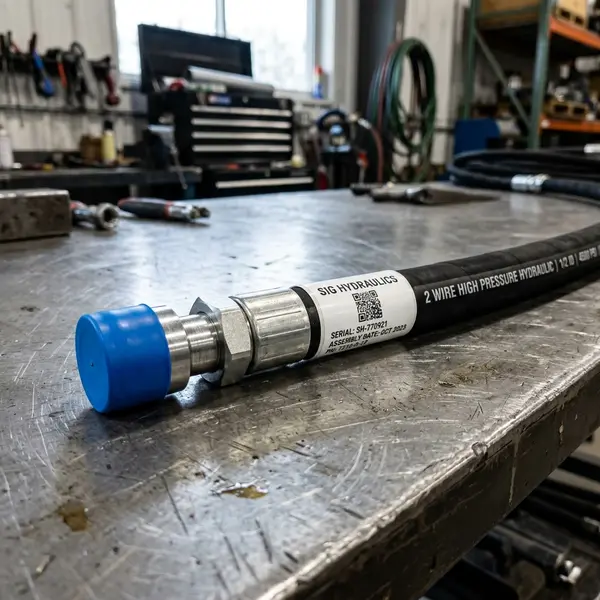
When a hydraulic hose appears to be leaking at a fitting, the wet connection does not tell you what is loose—or whether anything is loose. Treat the wet area as an observation, not as permission to approach, manipulate, or tighten the connection.
Put the safe state ahead of the photo
Do not approach, touch, or search a hydraulic leak until the procedure controlling the equipment and work has established safe access. Turning off an engine does not by itself prove that stored or residual energy is controlled.
Where OSHA’s general-industry lockout/tagout rule applies, potentially hazardous stored or residual energy must be rendered safe, and an authorized employee must verify isolation and deenergization before servicing starts. The rule has scope limits, including exclusions for construction and agriculture, so follow the employer’s applicable procedure, the machine manual, and qualified authority for the actual equipment and task. See OSHA’s hazardous-energy standard.
Never use a hand or bare skin to look for a leak. Do not loosen the connection, flex the hose, remove a guard, or restart and cycle the machine to improve the record. The Health and Safety Executive’s high-pressure fluid guidance identifies bare-hand leak searches and failure to release pressure as dangerous practices.
Suspected fluid injection needs immediate professional medical treatment. The HSE hydraulic-injection safety alert says to seek medical attention immediately after a suspected injection injury.
If the safe state or viewing position is uncertain, stop. Existing machine records and an operator’s factual account are more useful than a closer photo taken inside a hazard area. For a fresh rupture or active emergency, begin with the safe first steps after a hydraulic hose failure instead of this documentation task.
Preserve the connection before anyone changes it
Parker’s fitting-leak guidance warns against instinctively tightening a connection before assessing it. It also notes that the place where fluid drips may be different from the place where it escaped. Read the manufacturer’s fitting-leak cautions.
Use plain observations. “Fresh oil visible below the valve-end nut” preserves what was seen. “Loose fitting” assigns a cause that the observation alone does not establish.
Separate wetness from the actual leak source
Parker’s caution is simple: a drip point may not be the leak point. Keep the record honest by distinguishing three locations:
- Visible wet area: where wetness can be seen from the existing safe viewing position.
- Drip or collection point: where fluid is hanging, pooling, or reaching the ground.
- Unobserved area: any part hidden by a guard, sleeve, bundle, structure, dirt, or unsafe access.
These are observation fields, not a troubleshooting result. Fluid on a nut does not prove the nut is loose. Fluid below a connection does not prove the connection is the source. A dry-looking section does not prove it is intact. Record what is visible and leave disassembly, cleaning, inspection, testing, and cause assignment to qualified personnel under the controlling procedure.
Keep identification separate from diagnosis
A fitting shape in a photo may narrow the next question, but appearance alone does not confirm thread form, sealing method, size, condition, compatibility, or the correct replacement. Preserve readable marks and the connected component identity. The separate hydraulic fitting identification guide explains which measurements and references qualified personnel may need.
The same rule applies to torque. A generic torque value or the fact that a wrench fits does not establish the correct action. Connection type, material, size, condition, manufacturer instructions, and the surrounding components matter. Gates notes that over-torquing can damage threads and seat angles in its Hydraulic Maintenance & Safety guide.
Gates’ guide also separates visual recognition from measurement. Its coupling-identification pages call for checking thread diameter, thread count or pitch, and the sealing-seat angle. Those are controlled inspection steps for qualified personnel, not guesses to make from a phone image. A photo of a hex shape or visible thread is therefore a starting reference, not a confirmed fitting specification.
The Gates identification sequence begins by deciding whether the connection uses threads, then whether those threads are parallel or tapered. It next calls for measuring outside or inside thread diameter, comparing pitch with a thread gauge, and identifying the seat or sealing surface. Skipping those checks turns a visual resemblance into an unsupported specification.
Know what the record does not prove
A wet connection, a visible fitting shape, and a wrench-sized hex answer three different questions—and none identifies the repair by itself. Parker’s guidance separates the drip point from the leak point. Gates separates recognition from thread and seat measurement. Taken together, those limits are a reason to keep the handoff descriptive.
That means the record should not say a nut is loose because oil is on it. It should not name a fitting standard from appearance alone. It should not turn a generic torque chart into permission to tighten. Diagnosis, cleaning, inspection, testing, assembly, and return-to-service decisions belong to qualified personnel working under the controlling procedure and manufacturer instructions.
Hand the observation to qualified service personnel
For the broader intake checklist, see the mobile hose service preparation guide. Review SIG’s mobile hose repair scope and Northeast Ohio service area for context. To share the equipment location, machine identity, and safely collected as-found record, use the SIG contact form.
Sources
- The control of hazardous energy (lockout/tagout), 29 CFR 1910.147 — OSHA
- High pressure fluid injection hazards — UK Health and Safety Executive
- Hydraulic injection injury — UK Health and Safety Executive
- 10 Things Not to Do When Your Hydraulic Fitting Leaks — Parker Hannifin
- Gates: 2025 Hydraulic Maintenance & Safety
- Mobile Hose Repair — SIG Hydraulics
- Service Areas — SIG Hydraulics
- Contact SIG — SIG Hydraulics