
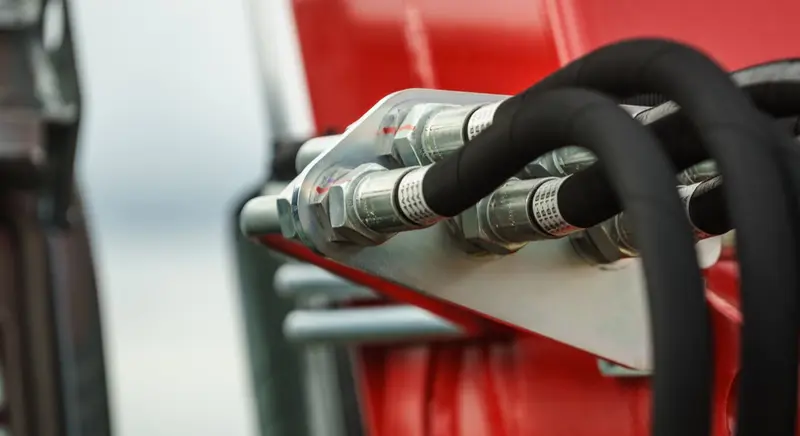
If a replacement hydraulic hose will not line up, seat, or follow its route without force, stop before installation. Compare the two complete assemblies instead of bending, twisting, trial-threading, adding an adapter, or rotating a crimped end to make the new hose fit.
“Does not fit” is not one diagnosis. The mismatch may involve the connection at either end, the points used to measure overall length, the relative position of angled fittings, or the route the assembly must follow. Sorting those observations first gives qualified service personnel a better starting record.
Establish the safe boundary first
Do not begin this comparison on a pressurized or uncontrolled machine. The applicable equipment instructions, employer procedure, and qualified authority must establish the safe condition before anyone enters a hazard area, touches the assembly, or starts service work.
Where OSHA’s general-industry lockout/tagout rule applies, its purpose is to prevent injury from unexpected energization, startup, or release of stored energy during servicing. The rule has scope limits, so it is not a universal procedure for every machine or workplace. Use the procedure that actually controls the equipment and task. See OSHA’s hazardous-energy standard.
Never use a hand to search for a hydraulic leak, and do not loosen a connection just to see whether a replacement will start. The UK Health and Safety Executive’s fluid-injection guidance identifies bare-hand leak searches, incorrect couplings, makeshift repairs, and failure to release pressure as dangerous practices.
If the old hose is still installed, record only what can be observed from an already safe position. Leave removal, disconnection, pressure control, cleaning, inspection, installation, and return-to-service decisions to qualified personnel working under the controlling procedure.
Turn “does not fit” into four separate comparisons
The useful question is not whether the replacement looks close. It is which physical detail differs. Keep End A and End B consistent while comparing the old and new assemblies so the observations do not get reversed halfway through the record.
1. Connection and sealing surface at each end
A similar-looking hex or thread does not confirm the same connection. Thread form, size, pitch, sealing surface, seat angle, port condition, fitting material, and manufacturer requirements can affect compatibility. Do not trial-thread parts or treat wrench fit as identification.
Use the separate hydraulic fitting identification guide to understand what a qualified person may need to measure. A photo can preserve shape and markings, but it cannot approve a connection or substitute for the correct specifications.
2. Overall length and its reference points
Two assemblies can be described with the same nominal length and still differ if they were measured from different points. Muncie Power’s hose measuring guide shows that the reference can depend on the fitting: male ends are measured to the tip, while examples for female, ORFS, flange, and elbow ends use other defined points.
Write down both the measured value and the endpoints used. “36 inches overall” is incomplete if one person measured to a thread tip and another measured to a sealing face or elbow centerline. Do not cut, stretch, preload, or reroute a hose to erase that difference.
3. Relative angle of two bent fittings
When both ends are angled, overall length alone is not enough. Their relative orientation—often called fitting orientation or clocking—determines whether both ends can meet their connections without twisting the hose.
The Gates hydraulic hose and couplings catalogue describes fitting orientation for two angled couplings by holding one end vertical, viewing from the other end, and measuring clockwise. The Muncie guide uses an End A and End B reference for the same kind of orientation record.
A degree value without the viewing direction, reference end, and endpoint labels is ambiguous. Preserve those references with the number. Never rotate a crimped fitting or twist the hose body to chase the angle; send the mismatch back for qualified evaluation.
4. The installed route and machine position
An assembly that matches on a bench can still be wrong for the machine if the required route or bend differs. Caterpillar’s hose inspection guidance notes that an incorrect length can force improper bending or routing and that coupling orientation matters during installation to avoid twist.
Record the machine component, the two connection locations, the route as found, and the position in which the mismatch appears. The hose abrasion and routing guide explains how to preserve routing observations without turning them into a repair instruction.
Compare the assemblies without losing their identity
After qualified personnel have removed the old assembly under the controlling procedure, keep the old and replacement assemblies separate and labeled. Do not assume the old hose was correct merely because it was installed. Do not transfer an adapter; record which assembly and connection it came from, then leave reuse or selection to qualified personnel.
A short mismatch record can include:
- Machine or component identifier and the applicable manual or part reference.
- “Old End A,” “Old End B,” “New End A,” and “New End B” labels.
- Connection shape and sealing surface at each end, pending qualified identification.
- Overall length, the exact reference points used, and who took the measurement.
- For two angled fittings, the reference end, viewing direction, and observed orientation.
- Where the assembly first stops lining up and whether the problem appears at End A, End B, or along the route.
Describe the mismatch with physical nouns. “New End B elbow orientation differs from Old End B when the End A labels are aligned” is more useful than “wrong hose.” “Overall length differs when both assemblies use the same reference points” records the observation without inviting another fit attempt. Do not add pressure, tools, or repeated attempts to make the evidence more dramatic.
Know what this comparison cannot approve
Matching the ends, length, and orientation does not by itself approve an assembly. Hose construction, pressure and temperature ratings, fluid compatibility, fitting and hose compatibility, bend limits, installation requirements, condition, and machine specifications still require qualified evaluation using the correct manufacturer and equipment information.
Do not substitute a higher pressure rating or a visually similar part as proof of compatibility. The higher-pressure replacement guide explains why one larger number cannot approve the complete hose assembly.
Hand off the mismatch before another attempt
Keep the old assembly, the proposed replacement, the labels, and the short record together for review. The broader mobile hose service preparation guide covers the machine and location details that help frame a service request.
Review SIG’s mobile hose repair scope and contact SIG before traveling. Share the safely collected record first; the live service page asks for the equipment location and hose details so supported assembly and scheduling questions can be assessed without treating one photo or dimension as approval.
Sources
- The control of hazardous energy (lockout/tagout), 29 CFR 1910.147 — OSHA
- High pressure fluid injection hazards — UK Health and Safety Executive
- Hydraulic Hose Measuring Guide — Muncie Power Products
- Hydraulic Hose and Couplings Catalogue — Gates
- How to Inspect Cat Hydraulic Hose Assemblies — Caterpillar
- Mobile Hose Repair — SIG Hydraulics